01 / Positioning
Independent security. Clear decisions.
Web3Sec is the practice and publication. Raiders is its founder and the person behind the work. Describe the actual engagement, contribution and evidence rather than implying scale or universal coverage.
Name and relationship
Write Web3Sec in running text and Raiders for the person. Web3Sec.News may appear when quoting an external credit or the publication’s historical name. The dot in the artwork is part of its drawn treatment; it does not change the spelling of the brand. Use ‘Led by Raiders’ or ‘Independent practice led by Raiders’ where that relationship needs explanation.
Eight areas of work
Crypto operational security; smart contract security; web, API and full-stack pentesting; mobile app security testing; incident readiness and scoped response; AI and supply-chain security; technical writing and research; security strategy and technical GTM advisory. Select the relevant area for a message instead of placing every capability on every cover. Exact coverage and availability are agreed per engagement.
The mark’s visual idea
Four equal squares form a compact two-by-two grid. Three share the main color and the lower-right square provides an accent. It can express attention to one part of a connected system. This is a useful visual reading, not a claimed founding story or a fixed mapping to four services, pillars or certifications.
Public attribution
MITRE AADAPT lists Chirag Agrawal, Web3Sec.News, as a contributor to ADT1195 and ADT1195.001. SEAL’s Domain & DNS Security framework credits Raiders as author. Preserve the specific framework names and roles. These credits do not imply employment, service endorsement or certification. ETHSecurity Badge selection is recognition by TheDAO Security Fund, not a numerical researcher ranking.
02 / Geometry
Keep the mark simple and intact.
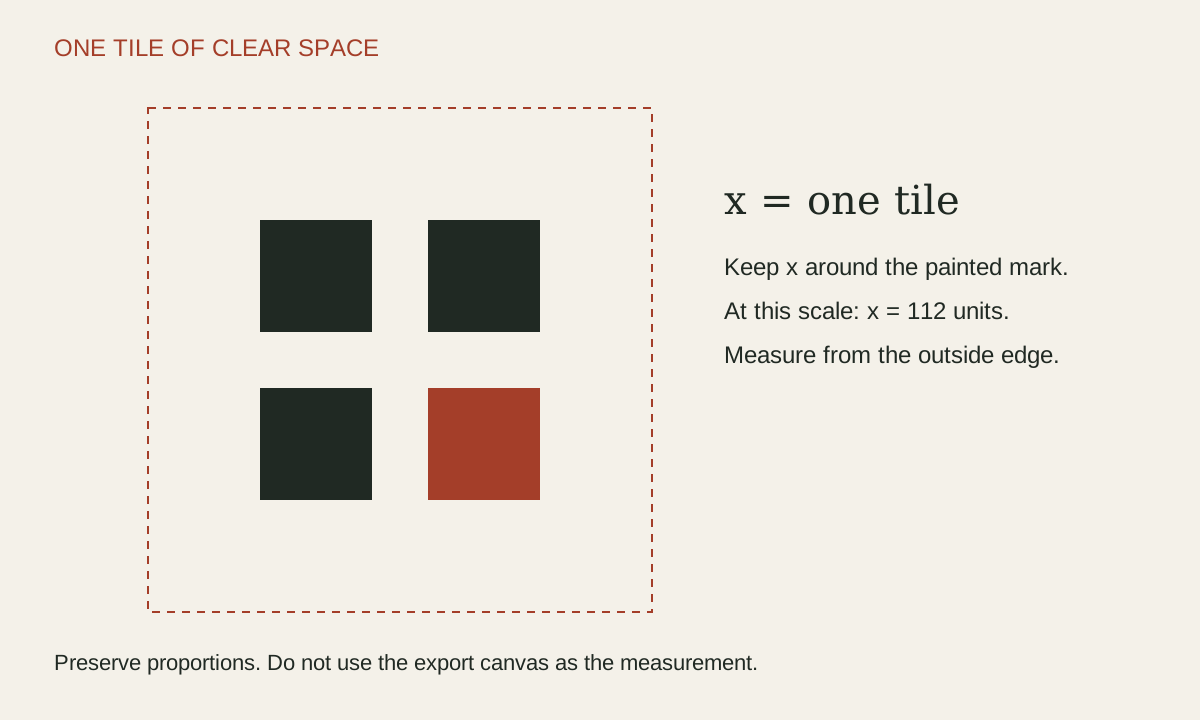
The master mark uses 16-unit tiles with an 8-unit gap inside a 40-unit painted square. Export padding and the SVG artboard are separate from that painted extent.
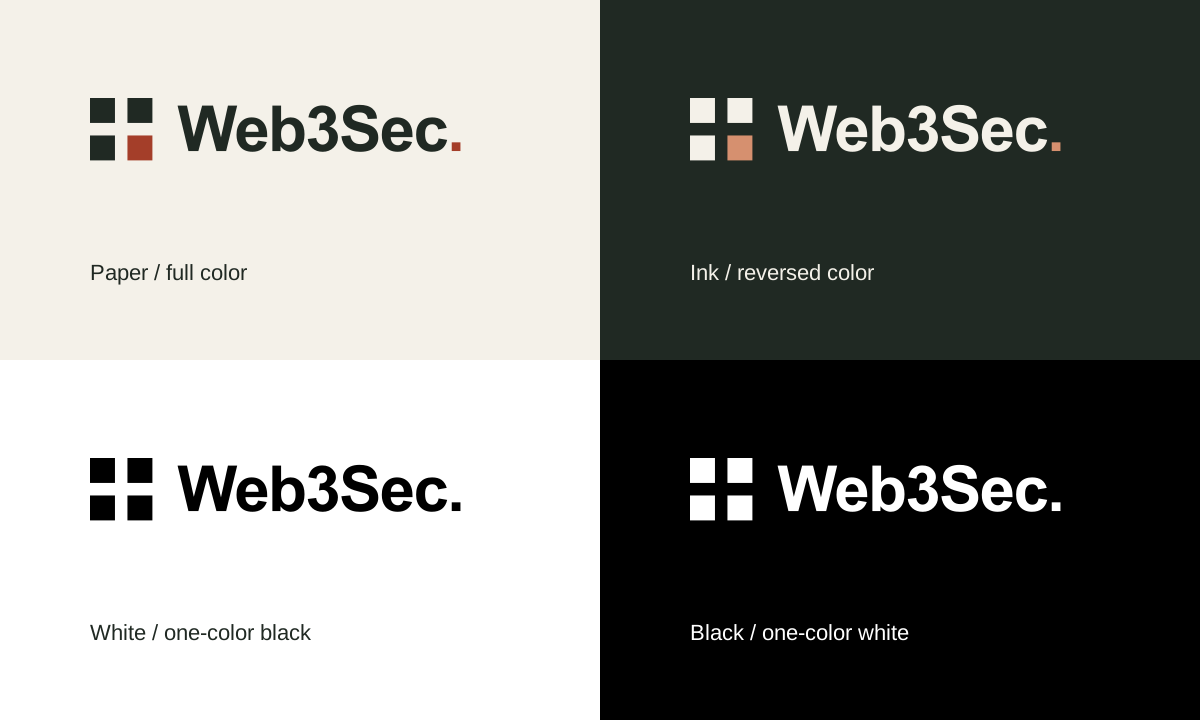
Lockup roles and production masters
Use logo-horizontal-{variant}.svg/png (1800×432) for headers, signatures and wide layouts; logo-stacked-{variant}.svg/png (1200×1000) for centered or narrow placements; logo-wordmark-{variant}.svg/png (1600×400) for the name alone; and logo-mark-{variant}.svg/png (1000×1000) for a standalone symbol. Replace {variant} with ink, paper, black or white. All production logo SVGs use outlined, font-independent glyphs. Preserve the supplied artwork; do not retype the name. Older wordmark-ink/paper exports remain editable live-font horizontal lockups, not the name-only production masters.
Clear space
Reserve at least one tile width around the painted logo or complete lockup. For a mark painted at width W, one tile is 0.4W: a 40px mark needs 16px clear space on each side. Leave more room beside dense type or a trim edge. Padding in an export may contribute to this space, but do not add it twice or measure from invisible artboard bounds.
Minimum reproduction
Recommended starting minima: painted mark 24px digitally and 6mm in print; horizontal lockup 140px or 30mm wide; stacked lockup 100px or 24mm wide. Inspect the actual name and tile gaps at final size. The site’s approved favicon is a deliberate small-size exception. Print, embroidery and engraving may need larger artwork after a production proof.
Backgrounds and misuse
The transparent ink variant uses ink plus terracotta on paper or a light neutral; the transparent paper variant uses paper plus peach on ink. Black and white are true one-color variants, preserving all four tiles. A transparent file supplies no background: choose a contrasting surface. Avoid stretching, rotation, rounded replacement tiles, gradients, shadows, outline-only restyling, random recoloring, added shields and low-contrast photographic placement. Outlined vector glyphs in production masters are solid filled shapes, not an outline-only visual effect. Use logo-clear-space, background-pairings and logo-usage-examples boards to check placement.
03 / Contrast
Warm paper, clear ink, restrained color.
Screen masters are sRGB hex values. The CMYK values below are rounded mathematical approximations, not press profiles or spot-color specifications. Confirm substrate, ink and output profile with the producer.
Primary palette
Ink #202923 - RGB 32/41/35, approximate CMYK 22/0/15/84. Paper #f4f1e9 - RGB 244/241/233, approximate CMYK 0/1/5/4. Use these for most surfaces and text; generous unprinted or quiet space is part of the identity.
Secondary and one-color palette
Terracotta #a43e29 - RGB 164/62/41, approximate CMYK 0/62/75/36. Muted #59615a - RGB 89/97/90, approximate CMYK 8/0/7/62. Peach #d6906f - RGB 214/144/111, approximate CMYK 0/33/48/16, for accents on dark surfaces. White #ffffff - RGB 255/255/255, approximate CMYK 0/0/0/0. Black #000000 - RGB 0/0/0, approximate CMYK 0/0/0/100. White and black are production alternatives, not replacements for the editorial primary palette.
Calculated text pairings
Using WCAG sRGB relative luminance: ink/paper 13.26:1; muted/paper 5.67:1; terracotta/paper 5.64:1; peach/ink 5.76:1; white/ink 14.97:1; white/terracotta 6.36:1; black/white 21:1. These solid-color pairs exceed the 4.5:1 AA threshold for ordinary text. Recalculate after changing opacity, overlay, gradient or background.
Pairings to avoid
Terracotta on ink is 2.35:1 and peach on paper is 2.30:1: neither meets ordinary-text or 3:1 large-text thresholds. Reserve these combinations for decoration that conveys no required information. Meaningful controls and graphical cues generally need 3:1 against adjacent colors. Use labels, patterns or position alongside color for allow/deny, severity and status.
04 / Editorial hierarchy
A readable publication, not a terminal theme.
The current system uses Georgia for editorial headings, Arial for reading and interfaces, and Courier New sparingly for small technical labels. Native fallbacks keep the site usable without a remote font request.
Families and roles
Headings: Georgia, Times New Roman, serif, normally regular weight. Body and controls: Arial, Helvetica, sans-serif. Technical metadata: Courier New, monospace. Avoid long uppercase paragraphs, artificial italics for body copy and monospaced prose. The wordmark is supplied artwork, not an invitation to reset the logo in a similar font.
Size and rhythm
Start digital body copy at 16-18px with 1.6-1.75 line height and roughly 55-75 characters per line. Use a restrained hierarchy: one title, a short deck, clear section headings and source metadata. Diagrams exported at 1200px wide should use at least 18px labels and be checked at their displayed size. For 16:9 slides, start around 36pt titles and 24pt body, then verify from the back of the intended room.
Licensing and export
Naming a system font in CSS does not distribute its font file. This kit does not bundle Georgia, Arial or Courier New font binaries or grant redistribution rights. Production logo masters contain fixed vector glyphs and need no installed font; editorial templates and legacy editable lockups still use live system-font text. Check operating-system, font and application licenses before embedding or transferring fonts. Supply a proof PDF or PNG for appearance and keep editable text where permitted. Do not retype or substitute the outlined logo; fixed vector artwork is not a license to redistribute font software.
05 / Evidence and action
Explain the boundary. Show the next step.
Write with the calm precision of a reviewer who has examined the system. Make the trigger, observed behavior, implication and action easy to find.
Useful language
Prefer ‘Review who can publish the frontend’ to ‘Unlock enterprise-grade protection.’ Prefer ‘Retested the stated build’ to ‘Fully secured.’ Separate what a source reports from our analysis; keep incident, disclosure and publication dates distinct. A caveat belongs beside the affected claim, not in a paragraph of repeated defensive language.
Taglines and calls to action
Primary: ‘Independent security. Clear decisions.’ Contextual alternatives: ‘Evidence for the decisions that matter.’ or ‘Review the paths that control your system.’ Use ‘Message Raiders’, ‘Scope an engagement’ and ‘Read the analysis’ for clear actions. These are positioning recommendations, not promises of prevention, recovery, ranking or commercial results.
Proof and independence
Name a report, contribution or funding record and link its source when making a credential claim. Collaborative credits stay collaborative. Do not turn a framework credit into an accreditation, badge selection into a top-50 ranking, funded public-goods work into a client endorsement, or an illustrative report into a real case study. Commercial relationships do not determine editorial conclusions.
06 / Explanatory art
Let the subject choose the composition.
Use diagrams, editorial shapes and restrained photography to help readers understand. A receipt, permission matrix, timeline or authority map can explain different questions more clearly than repeating the same flowchart.
Original visual language
Use paper, ink and terracotta with deliberate line weight and a limited number of labels. Keep diagrams technically meaningful and label illustrative fields. Avoid decorative code, fake dashboards, fabricated loss charts, stock hooded hackers and images that imply a live investigation. AI-generated artwork can illustrate a concept; it must not impersonate a real incident photograph, client artifact or endorsement.
Accessibility
Keep substantive information in HTML or the accompanying text as well as the image. Give an informative image an alternative describing its point; mark purely decorative artwork appropriately. Explain complex diagrams in a caption or nearby prose. Use a useful logo link name such as ‘Web3Sec home’. Review contrast, keyboard operation and zoom on the actual page, not just the exported artwork.
Motion and resilience
Motion should clarify a transition, never delay access to content. Provide a static state, honor reduced-motion preferences and avoid flashing, continuous parallax or attention-seeking loops. The message must survive disabled animation, JavaScript failure and image loading delays. Static SVG/PNG figures remain the portable sources for documents and sharing.
07 / Platform publishing
Upload the right asset to the right identity.
Platform specifications were checked against official help on 9 November 2026. Use PNG uploads from the manifest and inspect the platform’s actual crop before saving.
X
Recommended profile image 400×400; header 1500×500; bio maximum 160 characters. Use profile-light-400.png or profile-dark-400.png and x-header.png. Keep essential text clear of avatar overlap and edge crops. The supplied 155-character brand bio includes all eight areas; confirm character count again after edits.
LinkedIn
Personal background 1584×396, PNG/JPG, up to 8MB. Current English Page guidance specifies a 400×400 logo and 1512×256 cover, PNG/JPEG up to 3MB. Use linkedin-personal-cover.png for Raiders’ background and linkedin-company-cover-1512x256.png for the company cover. A 4200×700 alternate is supplied for interfaces requesting it. Preserve Raiders’ personal portrait; a company mark is not a personal likeness.
Publish and verify
Confirm the account, preserve its previous assets, upload the selected export, update the matching name/bio and website, preview desktop and mobile, then verify the public view. Use www.web3sec.news as the canonical site and existing verified public channels. A prepared kit does not imply an upload, post or account change has happened.
08 / Applied publishing
Make every document easy to evaluate.
Templates should make scope, evidence and ownership visible. A consistent footer is more useful than a large logo on every page.
Reports and proposals
Cover: document title, scope or system, author, version and date. Inside: reviewed artifacts, methods, findings, evidence, limitations and next actions. Use restrained headers and page numbers. Mark fictional samples prominently. Keep confidential evidence out of public templates, and use real text, headings and tables in exported PDFs where possible.
Slides and editorial covers
Start with template-slide-title.svg/png or template-slide-section.svg/png (1920×1080), template-report-cover.svg/png (1240×1754, A4 ratio) or template-research-square.svg/png (1080×1080). Edit document text, not the outlined logo. Pixel dimensions do not establish print resolution, trim or bleed. Use quiet margins, one main idea and sources beside claims. Editorial covers need a title, content type and date where useful. The site uses 1200×630 share cards; LinkedIn’s URL-post guidance recommends 1200×627, so inspect a platform-specific crop when needed.
Signature and publication refresh
email-signature.html provides a presentation example; the plain-text signature remains the reliable fallback: Raiders | Founder, Web3Sec; Independent security. Clear decisions.; www.web3sec.news; Telegram: t.me/Raiders0786. Test any HTML signature in the intended mail client with images blocked before adopting it. For an old Google title, verify deployed metadata, then use Search Console URL Inspection and Request indexing if authorized. Google controls recrawling and presentation; only record a submission after it happens.
09 / Physical production
Prove the material before approving the run.
Merchandise examples are production directions, not a manufactured inventory or a shop. The mark must remain recognizable on the actual material at its final size.
Artwork handoff
Send an outlined production logo master plus a raster placement proof. application-sticker-sheet.svg/png and application-tee-placement.svg/png illustrate placement; neither is a validated dieline, sewing pattern or production specification. concept-field-kit and concept-workshop-desk PNG/WebP files are generated visual explorations, not product photographs or manufacturing artwork. Specify finished dimensions, clear space, material, print position, colors and any white underbase. Agree bleed, safe area, dieline and tolerances with the producer.
Color and technique
Use a single ink for small engraving, embroidery or economical screen printing when detail would otherwise fail. Four-color mathematical conversions are only starting references. Choose physical spot-color swatches with the producer and approve a strike-off or sample; no Pantone match or thread code is implied by this kit. Ask the embroiderer to test the 8-unit gaps and tile corners at the chosen size.
Proof and release
Approve an actual-size proof on the intended substrate before quantity production. Check color under appropriate light, edge quality, legibility, wash or abrasion behavior when relevant, and packing. Record the supplier, artwork version and approved sample. Do not publish a mockup as a photographed or available product.
10 / Distribution and care
Share accurate assets and preserve context.
Downloadable artwork helps identify Web3Sec accurately. Availability is not a trademark registration claim, a formal brand license or permission to imply a partnership.
Identification and approval
Use the current name and artwork when accurately referring to Web3Sec. Ask Raiders before co-branding, merchandise sales, modifying the mark or using it in a way that suggests sponsorship or endorsement. Third-party logos, article excerpts, photos and font software retain their own rights and requirements.
Download and handoff
brand-kit.zip is the complete bundle; logos.zip contains logo artwork; social-kit.zip contains profile and cover exports; templates.zip contains editable templates and application boards. design-tokens.json and colors.css provide implementation values; palette.ase is an RGB swatch palette, not a press profile. Use brand-manual.html for the reading/print view and brand-guide-v2.pdf when included in the generated download set. The manifest is the inventory authority; check an optional export before linking it.
Version and asset integrity
Keep production SVGs, editable sources, generated PNGs, the manifest and this dated guide together, with their roles clearly named. Review the contact sheet, dimensions, transparency, crop and links before distribution. Remove superseded files from an external handoff rather than making recipients guess. Preserve font-independent masters and do not add scripts or remote resources to any SVG. Regenerate the manual and bundles after changing guidance so downloaded copies match the public page.
Copy-ready descriptions
One sentence
Web3Sec is an independent security practice and research publication led by Raiders, connecting technical evidence with clear decisions.
X brand bio · 155 characters
Security by Raiders: crypto OpSec, contracts, web/API, mobile, AI/supply chain, incident readiness, technical writing & security/GTM advisory. web3sec.news
LinkedIn company tagline · 114 characters
Crypto OpSec, contract/web/API/mobile testing, AI & supply-chain security, incident readiness, writing & advisory.
LinkedIn company About
Web3Sec is an independent security practice and research publication led by Raiders.
Engagements cover crypto operational security, smart contract security, web/API and full-stack pentesting, mobile app security testing, incident readiness and scoped response, AI and supply-chain security, technical writing and research, and security strategy and technical GTM advisory. Scope, access, availability and specialist needs are agreed for each engagement.
Public contributions include Raiders’ authorship of SEAL’s Domain & DNS Security framework. MITRE AADAPT lists Chirag Agrawal, Web3Sec.News, as a contributor to Supply Chain Compromise (ADT1195) and Compromise Software Dependencies and Development Tools (ADT1195.001). These credits describe specific contributions.
The publication turns primary incident reports and technical documentation into source-linked analysis and practical operating guides. Explore the work at https://www.web3sec.news/ or message Raiders at https://t.me/Raiders0786.
Raiders personal headline
Raiders | Founder, Web3Sec | Crypto OpSec, contract/web/API/mobile security, AI, incident readiness & technical advisory
Raiders personal About
I’m Raiders, founder of Web3Sec. My work connects the code, applications, identities, devices and operational dependencies around crypto systems.
Engagements can cover crypto OpSec, smart contract reviews, web/API and full-stack pentesting, mobile app security, incident readiness and scoped response, AI and supply-chain boundaries, technical writing and research, and security strategy or technical GTM advisory. Each engagement starts with the actual system and decision, then agrees on coverage and evidence.
I’m credited as author of SEAL’s Domain & DNS Security framework. MITRE AADAPT names Chirag Agrawal, Web3Sec.News, as a contributor to ADT1195 and ADT1195.001. I was selected as an ETHSecurity Badge holder by TheDAO Security Fund in April 2026.
Research: https://www.web3sec.news/
Telegram: https://t.me/Raiders0786
GitHub: https://github.com/Raiders0786
X: https://x.com/__Raiders
Newsletter: https://web3secnews.substack.com
Plain-text signature
Raiders | Founder, Web3Sec
Independent security. Clear decisions.
https://www.web3sec.news/
Telegram: https://t.me/Raiders0786