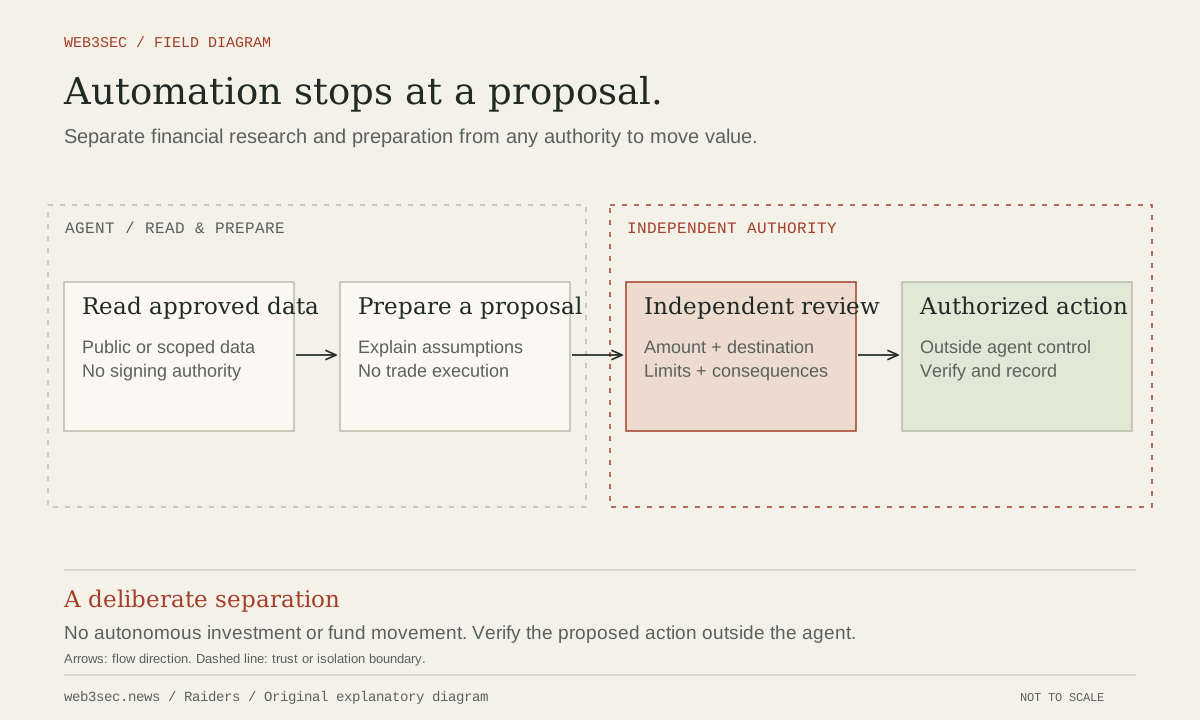
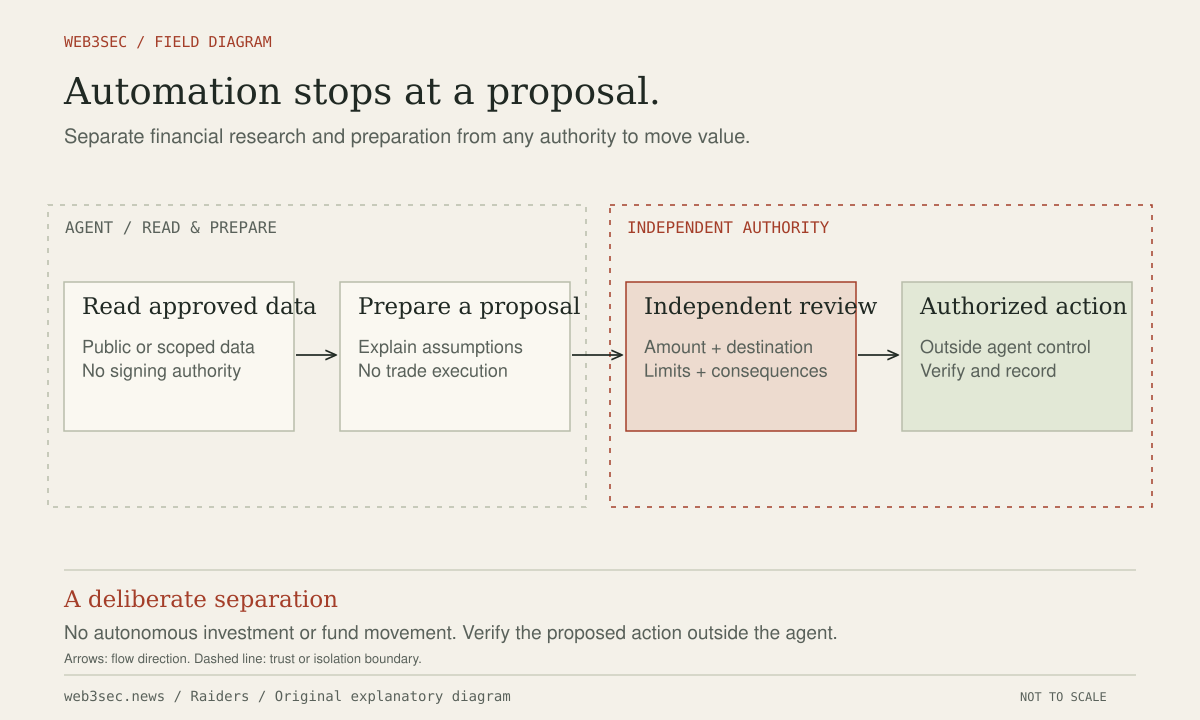
Define the operational role before connecting an account
The account or treasury owner should specify whether the agent may read statements, categorize transactions, prepare a payment or execute it. These are separate operating roles. Document account identifiers, currencies, permitted recipients, limits, approval owners and the actions explicitly outside the task, including beneficiary changes, withdrawals, credential recovery and permission changes. Keep research access separate from the identity that can move funds.
Inspect the actual bank, exchange, wallet or payment API permissions. Determine whether a key marked trading or payments also permits withdrawals, recipient creation or administrative actions. Use the narrowest supported account and credential configuration for the task. This guide addresses operational controls for financial tools; it does not select assets, recommend investments or assume that a platform offers any particular restriction.
Bind approval to the exact proposed action
OWASP’s transaction-authorization guidance emphasizes reviewing meaningful transaction data and enforcing authorization on the server. RFC 9396 describes structured authorization details rather than relying exclusively on broad OAuth scope strings. Where a provider supports fine-grained authorization, use its documented mechanism; a structured model response by itself does not create an enforced limit at the financial service.
Our procedure is to generate a transaction manifest with source account, exact destination, amount, unit or currency, fees, execution time and any relevant contract calldata or spending approval. Display it through a trusted review path and make the approved values immutable through execution. A changed amount, destination, network or operation requires a fresh decision. An agent’s narrative that the transfer is routine is not a substitute for seeing those values.
Control independent verification and cumulative exposure
Verify new or changed payment details through a previously established channel. An invoice, email thread, search result or chat message must not update the recipient allowlist on its own. Separate the ability to propose a beneficiary from the authority to approve one. For wallets, distinguish native transfers, token approvals, permits and contract administration; an operation that moves no funds immediately can still grant future spending authority.
Set per-action and cumulative limits where the executing service supports them, along with task expiration and a clear owner for exceptions. Review whether the same agent can change those limits, edit the approval policy or disable notifications. Keep the stop control and signer or provider administration outside its reach. Alert on denied attempts as well as successful executions so repeated blocked requests are investigated rather than silently retried indefinitely.
Test the failure before introducing real value
Use a provider sandbox, synthetic ledger or low-value test environment suitable for the platform. Try an unauthorized recipient, wrong currency, stale approval, duplicate request and small transactions that exceed the cumulative limit. Verify that the executing boundary rejects them even if the agent requests them. Test changed transaction values between approval and execution and confirm that an earlier approval cannot be reused.
During an unexpected execution, stop new authority, preserve provider transaction IDs and audit records and verify settlement status through the service directly. Revoking an API credential does not reverse a completed payment or an on-chain approval. Follow the provider’s established incident process and assess outstanding orders, scheduled actions and permissions. Restore access only after the transaction path and the demonstrated failure have been reconciled.
Controls to take away
- A proposal and a financially effective authorization are different steps.
- Review limits and destinations at the service that executes the action.
- Credential revocation does not undo an already executed transaction.
Work through the boundary.
These local worksheets turn the review questions into a plan. They do not inspect or change the actual account or environment.
Build a permission review plan ↗
Select the capabilities you are considering and review approvals, revocation and evidence before connecting an agent.
Take this to your next review
Working checklist
Use this as a starting point, then assign owners and record evidence in your team's own system. Checks here reset when you leave or reload this note.
0 of 5 reviewed
Common questions
Does explaining a proposed payment require permission to execute it?
No. Use a separate reading or preparation role when the task only needs analysis. Execution credentials introduce authority that a descriptive task does not require.
What must a transaction approval be bound to?
Bind it to source account, exact destination, amount and currency or asset, fees, timing and relevant contract effects. A change to those approved values requires a fresh decision before execution.
Why add cumulative limits when every transaction is small?
Repeated requests, retries and overlapping work can exceed the intended total exposure. Enforce aggregate limits at the executing service where supported, and prevent the agent from increasing its own limits.
Sources & further reading
The references below support this note. Adapt the procedures to your systems, access model and recovery requirements.
A correction or a better primary source? Send Raiders the article URL and evidence. Editorial policy.