Expertise / 06
Security strategy & technical GTM
Connect security priorities, product decisions, and a technical story that stands up to scrutiny.
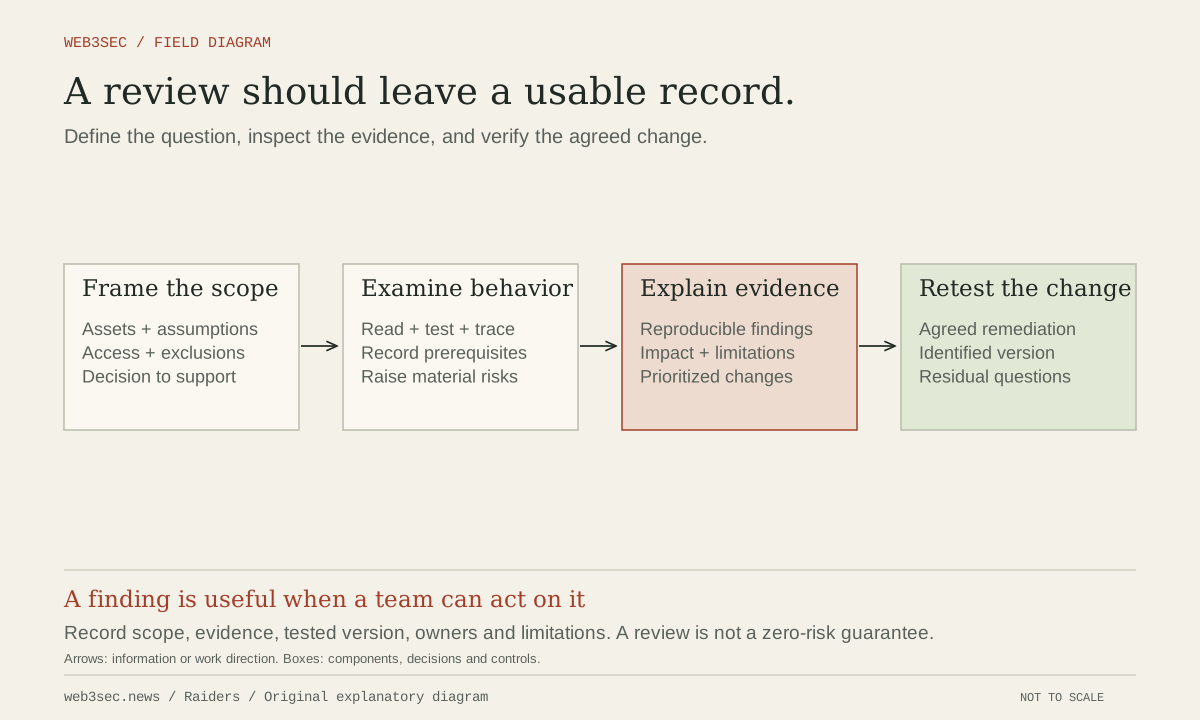
Define the question, inspect the evidence, and verify the agreed change.
Original Web3Sec diagram. On small screens, scroll the figure or open the full-size version.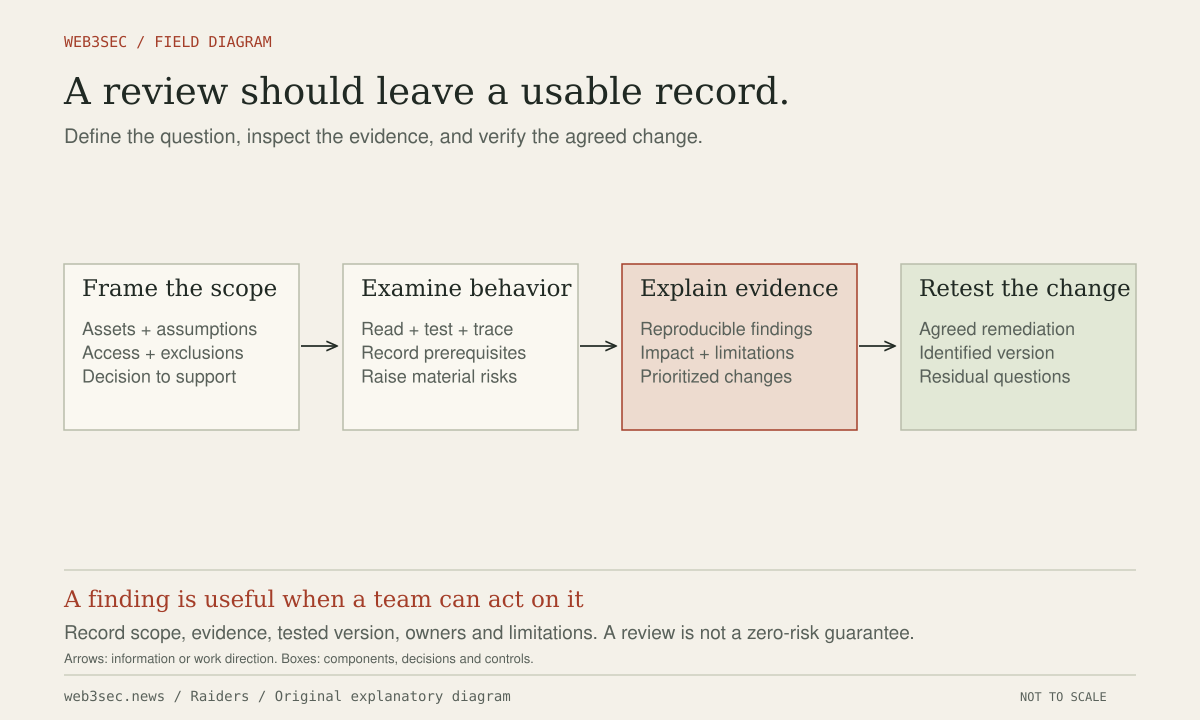
Who this is for
A clear question.
A useful outcome.
Founders and product leaders deciding what to secure first, how to prepare a launch, or how to explain a security product to technical customers.
Security advice is useful when it changes a decision. That may mean postponing a feature until its authority model is clear, narrowing a public guarantee, choosing the next engineering control, or explaining a product in terms a developer can verify. The engagement begins with the stage of the company, the system’s consequences, and the decisions the team needs to make. Advice is scoped to those needs rather than presenting a universal maturity checklist as a strategy.
What you should leave with
- Turn an ambiguous security concern into a prioritized set of decisions, owners, dependencies, and acceptance criteria.
- Align what the product actually does with what documentation, sales material, and launch messaging claim it can guarantee.
- Identify when a focused review, specialist engagement, operational change, or clearer communication is the right next investment.
Review boundary
What the work can cover.
Security prioritization
critical assets, trust assumptions, likely failure paths, current controls, ownership gaps, and practical sequencing of engineering work.
Launch readiness
consequential changes, unfinished findings, rollback capability, privileged access, response ownership, and evidence needed for a release decision.
Technical positioning
audience, use cases, differentiators that can be demonstrated, prerequisites, integration friction, and boundaries of security claims.
Developer-facing GTM
documentation journeys, technical demonstrations, research themes, evaluation criteria, and a credible path from interest to hands-on validation.
From context to evidence
How the engagement works.
Frame the decision
Share the product and architecture, current stage, customer questions, important constraints, existing assessments, and the decision deadline. Agree on the few questions that would make the engagement valuable and the evidence available to answer them.
Challenge and compare options
Review the system and supporting material, talk with relevant owners, and separate confirmed problems from assumptions. Compare choices by consequence, effort, dependencies, and what must be learned next. Escalate specialist questions rather than presenting guesswork as expert assurance.
Make the next steps concrete
Deliver recommendations with rationale, owners, sequencing, and observable completion criteria. Walk through disagreements and residual uncertainty. If continuing advisory is agreed, revisit decisions as product facts change instead of repeating the same generic roadmap.
Concrete outputs
Deliverables you can use.
Examples below are illustrative. They describe possible work products, not past client findings or promised results.
Decision and risk brief
A concise explanation of the choices in front of the team, evidence, assumptions, and recommended next steps. Illustrative example: deciding whether a new agent capability needs a narrower tool permission before launch.
Prioritized security roadmap
A practical sequence of work tied to assets and delivery constraints. Illustrative example: assign ownership of deployment credentials and test revocation before investing in a broader dashboard.
Technical positioning review
An evidence-aware review of product explanations and demonstrations. Illustrative example: replace an unsupported claim that a tool prevents all attacks with an accurate account of the behaviors it detects and the environments it supports.
Scope and responsibility
Boundaries worth agreeing early.
- Advisory does not replace a scoped penetration test, contract review, independent certification, or legal assessment. Recommendations reflect the information and access provided.
- Commercial terms, cadence, decision ownership, confidentiality, and potential conflicts are agreed directly. Client relationships do not buy favorable independent editorial coverage.
- No guaranteed revenue, fundraising, search rankings, compliance outcomes, or security results. Work is evaluated through the decisions and artifacts agreed for the engagement.
Before sharing code, customer information, or incident artifacts, agree on confidentiality and a private transfer channel. Keep the initial message high level.
Before we begin
Common questions.
Is this a fractional security leadership service?
An ongoing advisory arrangement can be discussed, but responsibilities and availability must be explicit. A title alone should not imply operational ownership, a staffed team, or authority that has not been agreed.
Can technical GTM and security review happen together?
They can inform each other, with clear boundaries. A technical assessment produces evidence; positioning explains what that evidence supports. Commercial objectives must not determine the severity or suppression of findings.
What if the recommendation is outside your scope?
The recommendation should say so. Some decisions need legal, infrastructure, cryptographic, or other specialist input. Identifying that dependency is more useful than pretending one adviser covers every discipline.
Go a little deeper
Practical reading.
Connected work
Related services.
Web & API pentesting
Follow the attack paths between identities, application workflows, APIs, and the systems they can reach.
Explore this service →04AI & supply-chain security
Examine what your agents can act on, what your build trusts, and how untrusted input can reach a privileged action.
Explore this service →05Technical writing & research
Turn complex engineering and security work into material that readers can understand, inspect, and use.
Explore this service →