Expertise / 05
Technical writing & research
Turn complex engineering and security work into material that readers can understand, inspect, and use.
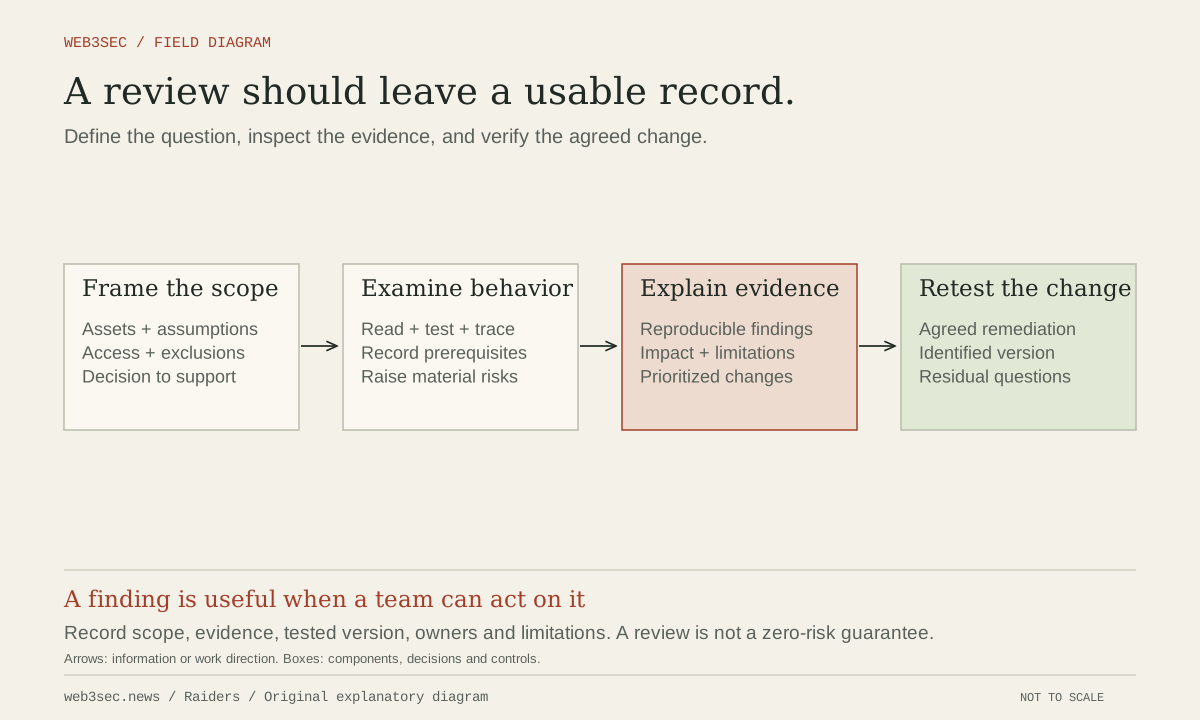
Define the question, inspect the evidence, and verify the agreed change.
Original Web3Sec diagram. On small screens, scroll the figure or open the full-size version.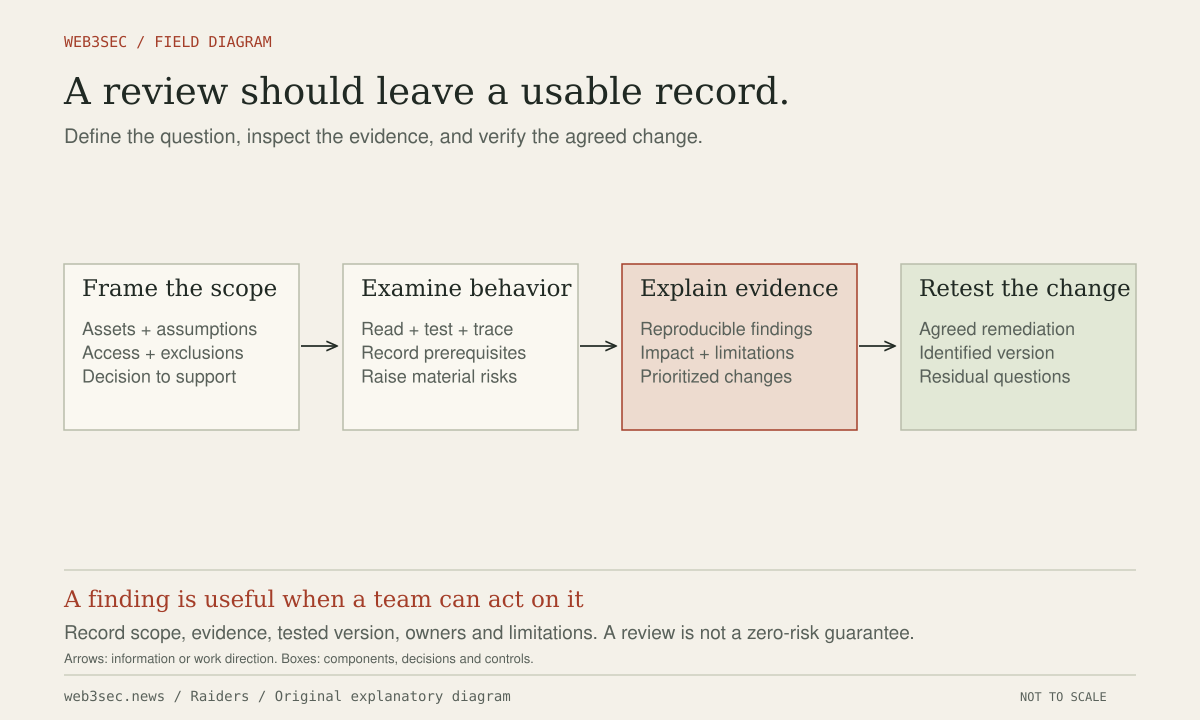
Who this is for
A clear question.
A useful outcome.
Security and developer-tool teams that need precise documentation, original technical analysis, incident communication, or credible developer education.
Good technical writing starts with the reader’s task and the evidence available. A postmortem should explain the failure and its limits; documentation should help someone use a system correctly; a research article should make its reasoning inspectable. The work combines interviews, source review, small reproducible examples where appropriate, and careful editing. It does not turn uncertain claims into confident copy or treat a product’s intended behavior as proof of its security properties.
What you should leave with
- Give a defined audience a clear answer to a practical technical question, supported by sources or reproducible behavior.
- Make the distinction between product capability, demonstrated evidence, assumptions, and interpretation visible to readers.
- Create a maintainable artifact with an owner, review process, and clear triggers for future updates.
Review boundary
What the work can cover.
Technical research
research articles explaining a security mechanism, attack path, defensive control, or technical tradeoff for an agreed audience and level of depth.
Developer documentation
developer documentation, integration guides, threat-model explanations, implementation notes, and migration material grounded in the current product.
Postmortems
incident narratives and postmortems that distinguish timestamps, observed events, reported facts, hypotheses, and corrective actions.
Launch education
technical launch content and education that explain how a product works, where it fits, and what its limitations mean for an engineering buyer.
From context to evidence
How the engagement works.
Define the reader and evidence
Agree on the reader, their decision or task, format, distribution, technical depth, and approval owner. Supply relevant code, design notes, demos, existing documentation, subject-matter access, and any confidentiality restrictions.
Research and draft
Develop an outline around the questions the reader needs answered. Verify factual claims against primary material, test examples in an agreed environment when appropriate, and identify gaps early. Attribute external investigation findings rather than implying independent forensic access.
Review and maintain
Separate technical review from editorial approval and resolve contradictory feedback explicitly. Deliver the agreed revisions, source notes, and any reproducible example assets. Record which product changes or new evidence should trigger a correction or update.
Concrete outputs
Deliverables you can use.
Examples below are illustrative. They describe possible work products, not past client findings or promised results.
Publication-ready draft
An original article, guide, or postmortem in the agreed format. Illustrative example: a walkthrough of a signing workflow that explains which details users must verify outside the browser interface.
Evidence and review notes
Sources, assumptions, open technical questions, and decisions made during review. Illustrative example: a claim about tenant isolation is narrowed because only one deployment configuration was tested.
Reusable supporting material
Agreed diagrams, examples, terminology notes, or distribution excerpts that stay consistent with the main text. These support a verified narrative rather than substituting for one.
Scope and responsibility
Boundaries worth agreeing early.
- Bylines, ownership, attribution, confidentiality, revision rounds, and publication responsibility are agreed before work. Client material is not automatically reused in public research.
- Writing an incident analysis does not establish an independent forensic investigation. Legal and regulatory statements require review by the appropriate client advisers.
- No invented customers, performance numbers, vulnerabilities, credentials, or guaranteed ranking and distribution outcomes. AI-assisted drafts require human technical and editorial review before publication.
Before sharing code, customer information, or incident artifacts, agree on confidentiality and a private transfer channel. Keep the initial message high level.
Before we begin
Common questions.
Can the work be published under our team’s name?
Byline and authorship arrangements can be agreed. The important point is that the technical content, approval responsibilities, source handling, and rights to reuse the material are explicit from the start.
Can you write about a confidential incident?
Yes, subject to an agreed confidentiality and review process. Decide which details can be shared, who approves factual claims, and how sensitive evidence will be transferred and retained before drafting.
Do you use AI for writing?
Tools can assist organization, editing, and exploration where permitted. Confidential inputs require an agreed handling policy. Every factual claim and technical example remains subject to human verification; generated text is not a primary source.
Go a little deeper
Practical reading.
Connected work
Related services.
Smart contract security
Challenge the assumptions, permissions, and economic edge cases in the code that moves value.
Explore this service →03Incident readiness & response
Prepare the decisions, access, and evidence your team will need when normal assumptions stop holding.
Explore this service →06Security strategy & technical GTM
Connect security priorities, product decisions, and a technical story that stands up to scrutiny.
Explore this service →